

- Type – free website builder (content management system).
- Video tutorial.
- Multilingual website advantages and disadvantages.
- Automatic website translation advantages and disadvantages.
Joomla has its own multilingual system, which allows you to organize «manual» translation of the site into several languages.
Video tutorial
- Installing Joomla language – 00:01:54.
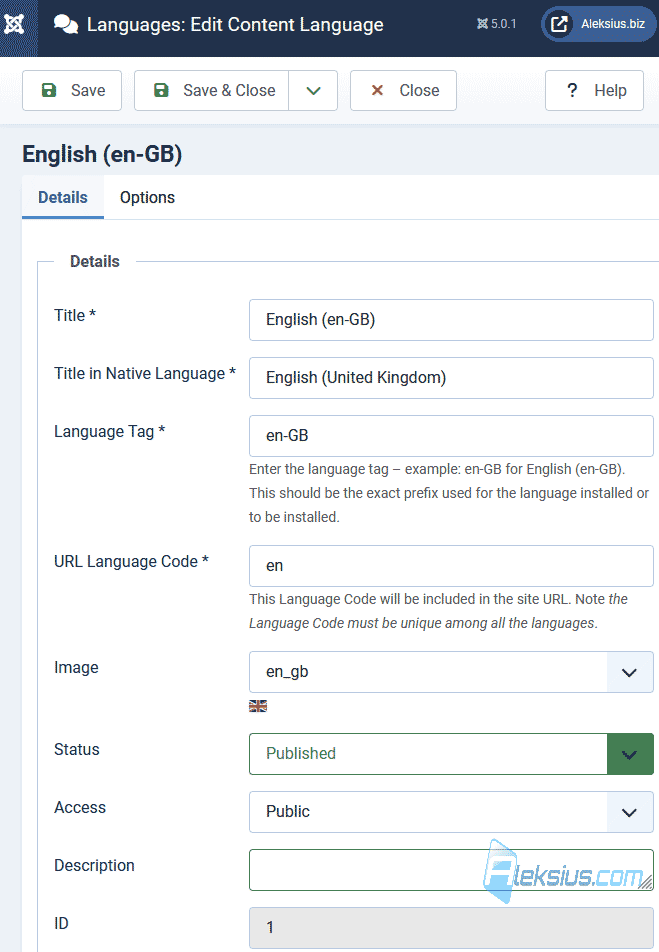
- Content Languages – 00:02:10.
- «System - Language Filter» plugin – 00:02:21.
- Article categories translation – 00:02:38.
- Article translation – 00:05:12.
- Contacts categories translation – 00:08:19.
- Contacts translation – 00:08:58.
- Menu translation – 00:09:32.
- Modules translation – 00:14:17. In Joomla 6.1, modules now have the ability to create language associations.
- Templates (styles) translation – 00:15:43.
- «Language Switcher» module – 00:17:12.
Better watch video with «1080p HD» quality. This and other video reviews and tutorials can be found on my YouTube channel.
Links from the video:
- Joomla 4 video tutorials.
- «TinyMCE video tutorial. Joomla text editor».
- «Joomla Com_content video tutorial. Articles options».
- «Video tutorial «Joomla 5 Contacts»».
- «Joomla menu video tutorial (Com menus). Creation and management».
- «Joomla Module video tutorial (Com modules). Creation and management».
- «Video tutorial «Joomla template manager»».
- Joomla video tutorials.
By «manual» translation, we mean that a person, and not an automatic translator, will directly translate texts and other content.
In previous free video tutorials, we created website on Joomla 4 from scratch. We used only free extensions. The result was a business website, which was uploaded to the hosting. The previously recorded video tutorials for Joomla 4 are almost completely relevant for the current version of Joomla 5.0. The information and video tutorial from this article remain relevant for Joomla 4 as well. At least this is true on January 5, 2024.
In this video we will look at the main Joomla multilingual setting up stages. The video tutorial contains basic principles of setting up built-in multilingual tools in Joomla. But for each specific site, this process can differ quite significantly. It depends on the extensions used on the site and other features of each project.
Video tutorial recording date – January 5, 2024. Software from video tutorial – Joomla 5.0.1. Starting with Joomla 5.2, you can create menu items for the main pages of the site's language versions in one menu, rather than in different ones.
Multilingual website advantages and disadvantages
Multilingual website Advantages.
- Global reach. Catering to a multilingual audience allows your website to reach a broader and more diverse global audience.
- Increased traffic. By offering content in multiple languages, you can attract users from different linguistic backgrounds, leading to increased traffic to your site.
- Enhanced user experience. Visitors are more likely to stay on your site and engage with its content if they can access it in their preferred language. This improves overall user experience.
- Improved SEO. A multilingual website can improve search engine optimization (SEO) by targeting keywords in multiple languages, making it more likely to appear in search results across different regions.
- Cultural sensitivity. Providing content in the user's native language demonstrates cultural sensitivity and can help build trust and rapport with international audiences.
- Competitive advantage. In some industries, having a multilingual website can give you a competitive advantage over competitors who only offer content in a single language.
- Access to local markets. If you're targeting specific international markets, offering content in the local language can help you establish a stronger presence in those regions.
Multilingual website disadvantages.
- Increased development and maintenance costs. Building and maintaining a multilingual website can be more resource-intensive, requiring additional time and budget for translations, updates, and technical support.
- Complexity in content management. Managing content in multiple languages can be complex, especially if changes need to be synchronized across all versions of the site.
- Translation quality. The quality of translations is crucial. Poorly translated content can lead to misunderstandings or miscommunication, potentially harming your brand reputation.
- Search engine challenges. While a multilingual site can enhance SEO, managing multiple language versions may present challenges, such as duplicate content issues or difficulties in targeting specific regional keywords.
- Potential for inconsistencies. Maintaining consistency in messaging and branding across multiple languages can be challenging, and inconsistencies may arise if not managed properly.
- Legal and compliance considerations. Depending on the nature of your content and the regions you target, you may need to comply with different legal and regulatory requirements, adding an extra layer of complexity.
Automatic website translation advantages and disadvantages
Automatic website translation advantages.
- Cost-effective. Automatic translation can be more cost-effective than manual translation, especially for large websites with extensive content.
- Rapid deployment. Automatic translation tools can quickly translate a website's content, enabling rapid deployment of multilingual versions.
- Real-time updates. Changes or updates to the original content can be automatically reflected in the translated versions, ensuring that all language versions stay synchronized.
- Broader reach. Automatic translation allows websites to cater to a global audience without the need for extensive manual translation efforts.
- Basic understanding. Automatic translation tools can provide a basic understanding of the content in different languages, making it accessible to a wider audience.
- Constant improvement. Machine translation algorithms are continuously evolving, and updates can lead to improved translation quality over time.
Automatic website translation disadvantages.
- Quality concerns. The most significant drawback is often the quality of the translations. Machine translations may lack accuracy, nuance, and cultural sensitivity, leading to misunderstandings or conveying unintended meanings.
- Contextual understanding. Machine translation tools may struggle with understanding the context of certain phrases or idioms, resulting in translations that may sound awkward or inappropriate.
- Industry-specific jargon. Technical or industry-specific language may be poorly translated by automatic tools, requiring human intervention to ensure accuracy.
- Lack of cultural nuance. Automatic translation may not capture cultural nuances and idiosyncrasies, potentially leading to content that feels disconnected or inappropriate in certain cultural contexts.
- Limited customization. Automatic translation tools may not allow for fine-tuning or customization based on specific linguistic or brand preferences.
- Security concerns. If your website deals with sensitive or confidential information, using external translation tools may raise security concerns, especially if the data is processed on external servers.
- Reputation risks. Poorly translated content can harm your brand reputation, as users may associate the inaccuracies with a lack of attention to detail or professionalism.
- Legal compliance. In certain industries or regions, legal requirements may necessitate accurate and verified translations, which automatic tools may not consistently provide.
In conclusion, while automatic website translation offers efficiency and speed, it should be approached with caution, particularly for websites where content accuracy, cultural sensitivity, and user experience are critical. Combining automatic translation with human oversight or professional translation services can help strike a balance between efficiency and quality.
In the next article «Video tutorial «Joomla Multilanguage (Part 2)»» we will look at tools that will speed up multilingual setup. We will also talk about «System - Language Filter» (this plugin was updated in Joomla 6) plugin and «Language Switcher» module.
I hope this and other Joomla video tutorials have helped you with this CMS. If you have any questions, ask them in the comments.
| Article author – Aleksej Khoroshevskij |
|---|
 Ph.D., lecturer at Kharkiv National University of Radio Electronics, web developer, and SEO specialist with over 15 years of experience. Expert in website creation using Joomla and WebSite X5. Author of scientific publications, video courses, and educational content on web development and SEO. Runs a blog and a YouTube channel, sharing knowledge and practical experience. Provides services in website development, customization, maintenance, and promotion. Learn more about the author… Publications and work: |
| Similar articles |
|---|
Useful links:
