

Since about 2008 until today, I've been creating «turnkey» websites on Joomla (in 99% of cases). I also handle their modification, SEO promotion, contextual advertising, hack protection, and loading speed optimization. I'm barely familiar with other CMSs. This article is my answer to a question from clients that pops up from time to time: «Why did you choose Joomla? Why not WordPress?». It's subjective because I have worked and still work almost exclusively with Joomla (with very few exceptions).
The article was written on June 20, 2026. It reflects only my opinion and is mainly aimed at my potential clients who are wondering, «Why not WordPress (or another program)?». I didn't bring in outside experts with experience in other website creation programs for this comparison. I don't code, so I can't judge the quality of Joomla's source code. The article looks at things from the perspective of a webmaster administering Joomla – someone who builds turnkey websites using ready-made extensions.
For convenience, I'll mostly avoid terms like «website builder», «engine», «content management system», or «platform». I'll just call everything a «website creation program» (or simply «program»).
Also, you won't find 100% foolproof arguments here in favor of choosing Joomla or any other website creation program.
Website Creation Programs
I don't know exactly how many website creation programs exist, but I found this list. It has 126 names, and here's a list with 963. Even I can tell these lists aren't exhaustive. Some of the listed programs are no longer supported (or the article just doesn't mention it). The first list has names missing from the second, and vice versa. If you remove duplicates, you get 1036 names. And that's still not the final list.
There are tons of rankings determining the popularity of website creation programs. For example:
- «CMS Market Share Trends: Top Content Management Systems (Oct 2025)».
- «CMS Market Share 2026: 80+ Statistics, Trends & Data».
- «CMS Market Share 2026: Statistics, Trends and Analysis».
Each of them has its own methodology. Depending on the method used, the results can vary significantly. But in the top 5 positions, you can usually find them side by side in any Joomla vs WordPress debate (especially when compared to open source CMS). At the same time, WordPress is always first, and by a massive margin.
Judging by the rankings, you should only choose WordPress for new websites or redesigns, since it's the most popular. But in reality, that's not what happens. People keep building new sites on various programs. This situation has many reasons. For example:
- Technical specifics of a particular project. There is no single universal, perfect website creation program that fits every single case.
- Developer preferences. Some developers prefer working with their chosen platform, and they often opt for various WordPress alternatives.
- Client preferences. The client might have gotten advice from friends, read convincing articles, or they (or their employees/subordinates) might have had previous experience with a specific program.
- Regional popularity. For instance, in Ukraine, you can find online stores built on «Prom.ua». On Ukrainian freelance sites, there are quite a few orders specifically for sites on «Prom». Meanwhile, I haven't seen such orders on the foreign freelance platform Upwork.com. The list of popular website creation programs may differ for each country.
I think there are plenty of other objective and subjective reasons why not everyone chooses WordPress.
Why I Chose Joomla
The short answer: by chance. Back in 2008-2009, I was looking for free video tutorials to learn how to build websites. I found a great course specifically on creating sites with Joomla. I made a blog for myself, built sites for a few friends, one for the university department where I studied, and since then, I've been building sites exclusively on Joomla (my portfolio doesn't show all the projects).
Over all this time building sites on Joomla, I've done landing pages, business card sites, corporate websites, blogs, directories, online stores, classifieds boards, and other «types» of sites. I also have my own personal projects: Aleksius.com, Aleksius.biz, Magazin.aleksius.com. Around 2022, due to the increasing complexity of projects, I started working more frequently in a team with a frontend developer, backend developer, marketer, and SEO specialist. Sometimes I also bring in copywriters, designers, and Linux server administrators.
I don't regret my choice. By 2018, it became clear that my hobby of making Joomla sites could become my main source of income. In 2018, I registered as a sole proprietor (FOP) and continue to develop websites. I still have no plans to swap Joomla for another website creation program or any WordPress alternative CMS.
Below, I'll list the most significant reasons why I chose Joomla:
- You can create sites of various types, complexities, focuses, and functionalities. Plus, the site can be in one or multiple languages.
- A multitude of extensions. Over 4,800 components, modules, and plugins that significantly expand Joomla's functionality.
- A multitude of templates. Hundreds, maybe thousands of ready-made designs. For example, Joomshaper.com, Yootheme.com, Gavick.com, Joomlart.com, Rsjoomla.com, Unitemplates.com, and others.
- Built-in core features. Lots of basic functions are available right out of the box without needing extra extensions. Sometimes I use nothing but Joomla itself, a template, and maybe 1-2 third-party extensions for a project.
- Update frequency. Updates are released about once a month.
- Availability of technical information. There are various forums, blogs, YouTube channels, and other informational resources where you can find what you need.
- A convenient admin panel. Again, this is my subjective opinion.
- Loading speed. On a normal, even «shared» hosting plan, Joomla sites can load pretty fast. It depends on the installed extensions, the template, settings, page content, and other factors. But it's entirely realistic to get a site up to 80-95 points on Google PageSpeed Insights (for mobile devices).
- Ability to create massive websites. With the right hosting, you can even run an online store on Joomla 3 and VirtueMart that, at the time of writing (June 20, 2026), boasts 1838366
- Basic SEO. Joomla itself has a minimal set of «features» for basic SEO optimization: metadata management, structured data implementation, «robots» meta tag management, a ready-made «txt» file, SEF URLs, redirect settings, and other «little things».
- Hack protection. With the right approach, Joomla sites can be well-protected from typical automated attacks. From 2008 to today (June 20, 2026), I only caught my personal site being hacked once. That was roughly between 2010 and 2012. I don't remember the exact Joomla version, but probably around 1.5-2.5. Since then, I haven't noticed a single hack.
- Specialists for custom modifications. The market, like freelance platforms, is full of various specialists who can tweak a Joomla site to meet specific project requirements. For example, writing plugins to integrate certain payment systems, «stretching» a custom design over Joomla, etc.
- Easy to find hosting. The market offers a huge number of hosting providers where Joomla works perfectly. The price range is very wide, starting right from free hosting plans.
And here are a few reasons why I don't like Joomla.
- Joomla isn't the only one, nor is it the number one most popular website creation program. Because of this, I constantly have to answer questions like: «Why not WordPress?», «Why not OpenCart?», «Why not Wix?», «Why not Shopify?».
- URL generation. Without third-party extensions, URLs in Joomla are generated based on the menu structure. This isn't always convenient.
- Lack of a built-in page builder. Because of this, you have to use third-party extensions like SP Page Builder, YOOtheme Pro, RSPageBuilder, and others.
I've never believed Joomla is the absolute best program for building any kind of site. I think a program should be chosen for a specific project based on its requirements and specifics. These specifics can include technical aspects, as well as budget, development timelines, trust in the developer, the client's previous experience, etc.
A Subjective Joomla vs WordPress Comparison
I'll say it again: I've hardly ever worked with WordPress. Therefore, I will judge its benefits based on articles that occupy the top 5 in Google search results for the queries «Benefits of WordPress». I'll highlight the 9 most significant advantages and try to compare them with Joomla.
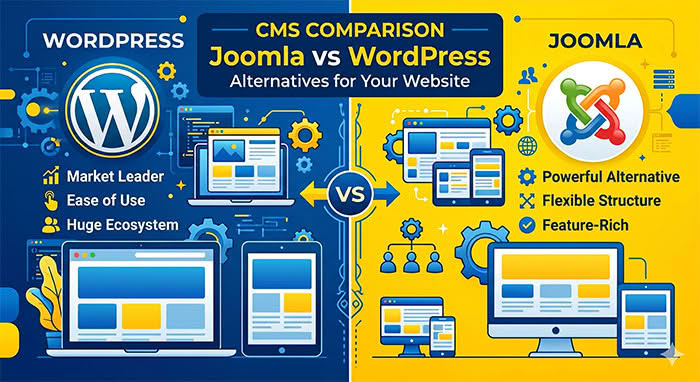
Advantage №1 – Ease of use. WordPress has an intuitive interface that allows even beginners to quickly figure out how to create and manage a site.
I'll probably just agree with this one. The convenience of the admin interface is mentioned in literally every article I read about WordPress. Moreover, in Joomla 4, the site's admin panel was significantly redesigned and visually started to strongly resemble WordPress. It's worth noting that if you aren't used to a certain admin panel and your site is built to order, custom video tutorials recorded specifically for you will make learning to manage your Joomla site much easier. They make it convenient and understandable.
Advantage №2 – Flexibility and scalability. With tons of plugins, you can customize a site for any need – from a blog to an online store.
The exact same thing can be said about Joomla. However, WordPress claims over 65,000 free plugins. Meanwhile, Joomla has only 4,832 paid and free extensions. Joomla loses by more than a factor of 13. But there is a catch here. For example, Joomla has about 27 extensions for creating online stores, but there is one clear leader – VirtueMart – and maybe 2-3 viable alternatives. You can say the same for other types: galleries, SEO extensions, performance optimizers, security tools, content builders, etc. After looking into the WordPress plugin situation a bit, I realized things are pretty much identical there. As for the pricing policy of WordPress plugins, it's exactly the same as with Joomla. There are free and paid extensions, but the paid ones are more functional and come with better tech support than the free ones.
Obviously, the more plugins/extensions, the better. But considering the presence of clear leaders in any given category, that 13x difference becomes much less significant.
Advantage №3 – A massive community. There's a huge community of users and developers ready to help with any questions or problems. This also leads to regular updates and improvements.
Regarding educational and reference materials for WordPress, I get the feeling there's more of it than for Joomla. However, it's worth noting that when ordering a «turnkey» website, you get a finished product, and you won't need to scour the web for how to configure custom fields or anything like that. You'll just use the already configured site. I record a training video for my clients directly on their specific website, and I also provide my own free video tutorials covering the core «parts» of Joomla. From experience, this brings the need to Google things extra down to almost zero. Plus, I try to answer any emerging questions as quickly as possible, even a long time after handing over the site.
As for developers (programmers) for website modifications. From experience, I know that on freelance platforms, you might easily get 20-40 proposals from freelancers for a WordPress site modification gig. And the price spread can be wild. For Joomla, you might get 3-10. Yet, the price spread might not be as drastic. But here's the thing: adequate, skilled developers will generally charge about the same price. So, out of those 40 WordPress proposals, you can immediately toss out almost half based on price alone. Still, in the case of WordPress, you will definitely have a larger pool to choose from.
Regarding updates. If we trust ChatGPT, for WordPress: «the total number of updates (including all types) can be 5-10 times a year or even more, depending on discovered issues and community needs». With Joomla, it's pretty similar – about once a month. Sometimes more often.
Advantage №4 – SEO-friendliness. WordPress is set up right out of the box to help improve site SEO. There are plugins like Yoast SEO that make the optimization process even easier.
I can say exactly the same about Joomla. I described this point earlier in the article, and as for third-party SEO extensions, Joomla has strong options too. For example, 4SEO and RSSEO.
Don't forget that modern SEO, in any more or less competitive niche, is a complex, multifaceted process that requires diverse work both on and off the site. The technical part is important, but it's not the «be-all and end-all». It's enough to ensure an adequate technical foundation for SEO promotion. And Joomla handles this task perfectly.
Advantage №5 – Themes and design. Thousands of free and premium themes let you easily change the look of your site without needing a designer.
I can't say there are thousands of templates for Joomla; there are definitely fewer than for WordPress. But there's a nuance. Judging by comments, reviews, and articles about WordPress themes, I see that not all themes fit the current version of WordPress, not all work equally well with all available WordPress plugins, and not all of them are actually good in terms of design. Anyway, it's the exact same story with Joomla templates.
Of course, a bigger choice is better. But from my experience, the vast majority of my clients never looked through the dozens of template options I offered them. Now, 3-5 options – that's a different story. As a client, you don't really care how many dozens, hundreds, or thousands of options exist out there. What matters is picking from 3-5 variations that best fit your briefly outlined project.
Advantage №6 – Security. Constant WordPress core updates and a massive number of security plugins help maintain a high level of site protection.
We already talked about update regularity in advantage №3 above.
Regarding security plugins, Joomla has them too. For example, RSFirewall or Admin Tools.
But when it comes to the actual level of security, things aren't so straightforward. Because of its undisputed popularity and massive number of third-party plugins, WordPress becomes the target of hacker attacks way more often than Joomla. There are far more articles about mass WordPress hacks than Joomla ones.
When it comes to maintaining a high level of website protection, WordPress and Joomla share almost identical problems. You need to regularly update the core CMS as well as their plugins and extensions; you need to install and configure dedicated security tools; monitor hosting settings and software versions on the server; use one isolated hosting account per site rather than cramming multiple sites into one; protect the admin panel; ensure there are no viruses on the devices you use to access the sites; choose responsible contractors, etc. It's a rather complex, continuous, and generally expensive process. And in this regard, WordPress and Joomla are very much alike.
Advantage №7 – Multilingualism. Support for many languages and the ability to create multilingual websites.
WordPress itself doesn't have built-in multilingual support. You have to install an extra plugin for that. Joomla has multilingual functionality built right into its core, plus there are alternative extensions from third-party developers.
As for the number of languages (as of June 20, 2026). For the latest stable version of WordPress, there are 67 translations (locales up to date) (not all of them are 100% complete). For the latest stable version of Joomla, there are 65 translations available (again, not all are full). It's worth pointing out that WordPress officially lists 208 translations. But they don't all fit the latest stable version, and they aren't all complete. As a result, we see that for their latest stable versions, WordPress and Joomla have roughly the same number of languages. I'll also note that while analyzing the available languages, I saw that both programs support all the languages I've ever needed to build sites in.
Advantage №8 – E-commerce. Plugins like WooCommerce make it easy to create an online store with product, order, and payment management.
Joomla also has around 27 components for creating online stores. For example, VirtueMart.
Advantage №9 – Mobile optimization. Most WordPress themes and plugins are optimized for mobile devices, ensuring the site looks great on various screens.
The situation is identical with Joomla. I haven't seen a single extension or template for Joomla 4, 5 or 6 that didn't support responsive design to ensure quality rendering across different devices.
Advantage №10 – The most popular. I'll add this WordPress advantage from myself. If a ranking looks at free «general-purpose» content management systems, which both WordPress and Joomla are, WordPress ranks as the most popular (number 1) in almost all of them. This gives you an undeniable answer to the question, «so why WordPress?».
Usually, in such rankings of free WordPress alternatives, Joomla takes second place. At the same time, if any quantitative metrics are shown, the gap between first and second place is huge.
In conclusion. As I promised at the beginning of the article, I don't have absolute, clear-cut arguments for choosing Joomla, WordPress, or other WordPress alternatives. I'll say it again: I've never believed and still don't believe that Joomla is the best program for building absolutely any site. It makes sense to choose a platform for a specific project based on its requirements and specifics. These specifics can include not only technical details but also the budget, development timeframe, trust in the developer, the client's previous experience, and more.
I hope I've given my clients and potential clients an answer to the question: «Why did you choose Joomla instead of WordPress?», even if it is a subjective one.
| Article author – Aleksej Khoroshevskij |
|---|
 Ph.D., lecturer at Kharkiv National University of Radio Electronics, web developer, and SEO specialist with over 15 years of experience. Expert in website creation using Joomla and WebSite X5. Author of scientific publications, video courses, and educational content on web development and SEO. Runs a blog and a YouTube channel, sharing knowledge and practical experience. Provides services in website development, customization, maintenance, and promotion. Learn more about the author… Publications and work: |
| Similar articles |
|---|
